

In the world of tennis, the most compelling stories often transcend victory and defeat, focusing instead on the collision of eras and the passing of the torch. On May 6, 2026, at the Sea Oaks Beach Tennis Club in Vero Beach, Florida, a truly historic showdown unfolded—the oldest and youngest active singles players on the ATP rankings met head-to-head for the first time.
The event was the ITF M15 Vero Beach tournament, a $15,000 prize-money event founded by former world top-10 player Mardy Fish. Beyond raising funds for local underprivileged children, it unexpectedly became the perfect stage for a dialogue between two generations of tennis.
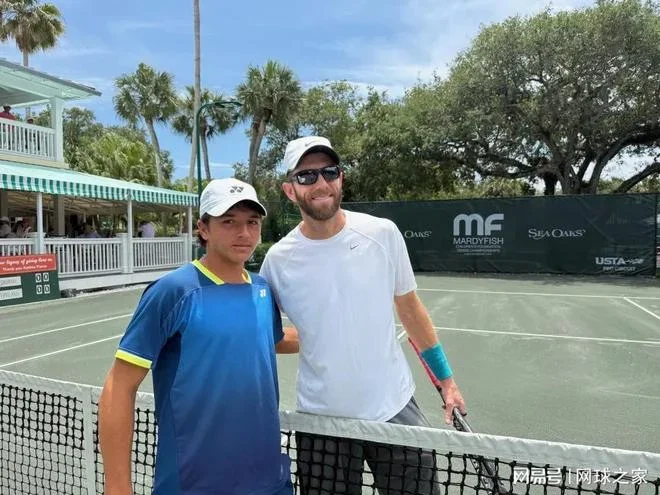
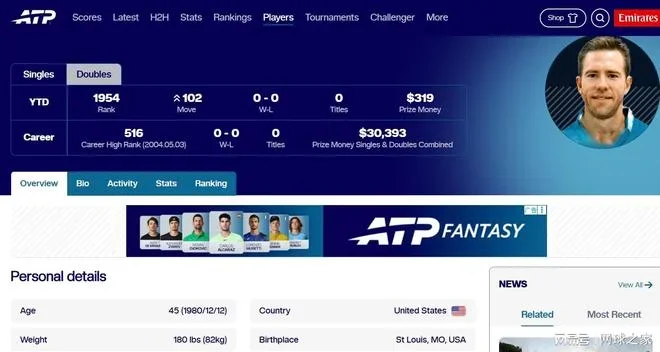
The contrast between the two competitors was staggering: 45-year-old American Ryan Haviland, ranked 1954th in the ATP, faced 15-year-old prodigy Teodoro Davidov, ranked 1594th. A 30-year age gap and such a disparity in rankings had never been seen in professional tennis history.
Haviland’s career is a story of perseverance and near-misses. A key member of Stanford’s NCAA four-peat in the 1990s, he turned professional in 2001 and reached a career-high ranking of 516th in 2004, securing five Challenger titles. However, 11 surgeries derailed his trajectory, keeping him from higher echelons. Now running his own tennis academy, he plays a few Challenger events each spring, driven not by glory but by an undying competitive fire and a desire to inspire the young players he coaches.
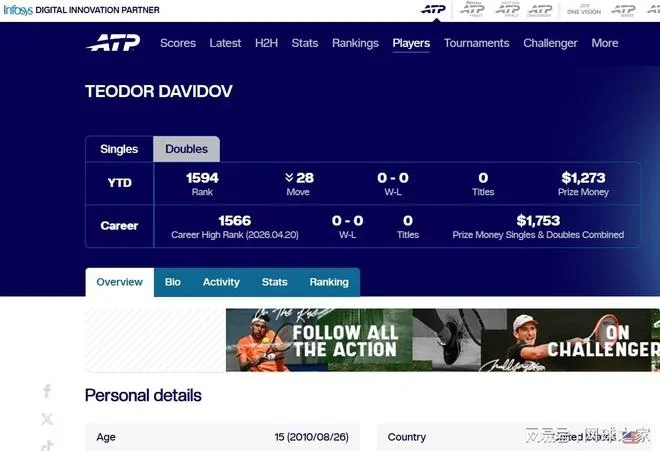
His opponent, Davidov, is a rising “phenom” with a unique style. Born in Bulgaria and trained in Bradenton, Florida, he employs a rare “double forehand” technique—using a forehand grip on both sides, serving right-handed on the deuce side and left-handed on the ad side. In February 2025, he earned his first ATP points at a Florida tournament, becoming one of the youngest players on the ATP rankings. His talent and unconventional approach have caught the eye of the tennis world.
Before the match, the young star showed maturity beyond his years: “He’s older, wiser, and has a lot of experience. I can’t underestimate anyone. I have to play my absolute best.” Haviland, meanwhile, marveled at the passing of time: “I used to play guys half my age. Now I’m facing someone a third of my age for the second time in weeks.” He acknowledged the challenge posed by Davidov’s unusual game, noting there was no traditional backhand to target.
The match itself was a rollercoaster, fully deserving the “historic” label. In the first set, Haviland was broken while serving for the set at 5-6, and Davidov took the tiebreak 7-2 with a burst of aggressive play. In the second set, the veteran adjusted, upping his first-serve percentage to race to a 5-1 lead. Though Davidov fought back to 3-5, Haviland held firm, converting on his sixth set point to level the match. The deciding set was a 10-point tiebreak. Haviland raced to a 6-1, 8-3 lead, but the teenager refused to yield, clawing back to 8-6. In the end, the older man sealed the victory with a trademark wide serve and an overhead smash, winning 6-7(2), 6-3, 10-6 to advance to the main draw.
“This is a victory for the older generation,” said Haviland after the match, visibly moved. “I’m on the downside of my career, and he’s rising. I just survived.” He praised his opponent: “I’ve never played anyone like him. Usually you aim for the backhand, but he has two forehands—both are weapons.” The defeated Davidov was reflective: “My energy dropped, my focus wasn’t there. I was too passive and didn’t step in. He has incredible stamina and endurance. I need to maintain a more consistent mindset and form.”
A 30-year age gap—on one side, a lifelong passion; on the other, a budding future. Haviland won with experience and willpower, while Davidov earned respect with talent and courage. This match, lacking big-name stars or huge prize money, captured the purest essence of tennis: it’s not about age, only about love for the game. Some persist through the years, others begin their journey at dawn. Two generations spoke through their rackets, crafting one of tennis’s most heartwarming stories. In this clash across three decades, there were no losers—only passion and legacy, forever etched in memory.
